Design

Utopia and its discontents

I’m a huge fan of Neal Stephenson, and also of his newest project [Hieroglyph](http://hieroglyph.asu.edu/), which aims to inspire future scientific breakthroughs with optimistic near-future science fiction. But I found two critiques of the approach quite compelling this week.

First, Virginia Postrel (whose writing on design I’ve enjoyed in the past), writes that “[Peter Thiel Is Wrong About the Future](http://www.bloombergview.com/articles/2014-10-08/peter-thiel-is-wrong-about-the-future)” (I’m reading his book as well), and mentions Hieroglyph as similarly misled:

> The dystopian science fiction Stephenson’s Project Hieroglyph aims to counter isn’t the cause of our cultural malaise. It’s a symptom. The obstacle to more technological ambitions isn’t our idea of the future. It’s how we think about the present and the past…

> The reason mid-20th-century Americans were optimistic about the future wasn’t that science-fiction writers told cool stories about space travel…*People believed the future would be better than the present because they believed the present was better than the past*. They constantly heard stories — not speculative, futuristic stories but news stories, fashion stories, real-estate stories, medical stories — that reinforced this belief.

It’s the same ambivalence toward today’s progress that [Louis CK rails about](https://www.youtube.com/watch?v=uEY58fiSK8E), and that [many science fiction writers and futurists recognize](http://bob.ryskamp.org/brain/?p=5326). We do live in amazing times, yet the dominant cultural reaction is frustration and dissatisfaction. We don’t often celebrate the incredible progress we’ve achieved. As [David Brooks once wrote](http://bob.ryskamp.org/brain/?p=481), “Americans have always been united less by a shared past than by the shared dream of a better future.”

The Guardian also [confronts the Hieroglyph collection](http://www.theguardian.com/books/booksblog/2014/oct/10/science-fiction-utopia-wilful-ignorance), calling the stories “built on willful ignorance”:

> But there is also a deliberate naivety to Project Hieroglyph. Stories such as Cory Doctorow’s The Man Who Sold the Moon are a veritable hymn to the culture of Silicon Valley and tech start-ups, but deftly wave away the part these cultures play in today’s corporate capitalism and all the inequalities that come with it.

I agree with their assessment of the best stories:

> The best contributions to Hieroglyph are the least optimistic, and the best attuned to the human reality that technology so often obscures. Entanglement by Vandana Singh and Madeline Ashby’s By the Time We Get to Arizona both look at the impact of new technologies in developing nations and among the world’s poorest people. They also tackle the obvious problem of technological innovation, the looming menace of climate change, environmental degradation and resource depletion that go hand in hand with new technologies.

I still believe there is a role for optimistic science fiction in changing the world. However it’s always good to be mindful of the present and past when thinking about the future, and to include messy and uncomfortable situations in even the most polished vision. The real future will be both based in today’s world and include a lot of today’s problems, and people are wise enough to recognize when those aspects are missing from stories about the future.
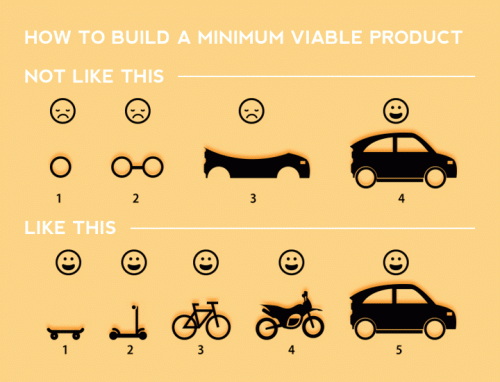
Think small

[A nice example of thinking small first](http://blog.fastmonkeys.com/2014/06/18/minimum-viable-product-your-ultimate-guide-to-mvp-great-examples/), similar to [Brandon Schauer’s Cake model](http://brandonschauer.com/post/3309932285/more-on-the-little-secret-to-product-planning-cupcakes).

Solving the right problems

> Design is about solving problems that humans have, not problems that products have. – [Mills Baker](http://mokriya.quora.com/Designer-Duds-Losing-Our-Seat-at-the-Table)

I’ve referenced this quote several times since reading it; this is harder to do than you might think.

The boring future

> One of the defining challenges of writing science fiction is explaining to the audience the amazing new things in this world while respecting the fact that the characters already live in that world… For you, this future is cool, but for them it’s just another day with the same old problems.

– [John Scalzi](http://en.wikipedia.org/wiki/John_Scalzi), speaking at Google

See also Jamais Cascio, “[Your Posthumanism Is Boring Me](http://io9.com/5533833/your-posthumanism-is-boring-me)” and “[Fifteen Minutes Into the Future](http://www.openthefuture.com/2008/05/fifteen_minutes_into_the_futur.html)”, and Stuart Candy, “[Amazing=Mundane](http://futuryst.blogspot.com/2009/03/amazing-mundane.html)”.

Product design and your impact

I’ve written before about [how I think about and talk about design](http://bob.ryskamp.org/brain/?p=4367). While in general I find it important to be specific about the practice you’re doing, there are some broader definitions that are useful.

One that occurred to me this morning: *The first act of product design is deciding what effect you want to have in the world.*

This definition sidesteps [the distinction between solving problems and cultural impact](http://bob.ryskamp.org/brain/?p=4126), and focuses not on the product but on the opportunity.

We live in a fascinating time, where with [new](http://en.wikipedia.org/wiki/Smartphone) [tools](http://en.wikipedia.org/wiki/3D_printing) we have the power to build almost anything. Meanwhile, design practice is emerging in many disciplines and fields. The question is then less about “what should we build” and more about “why should we build?” Make sure you know your answer.

Faster horses and tone-deaf designers

> If I’d asked my customers what they wanted, they’d have said a faster horse – Henry Ford (allegedly)

This quote has always bothered me. Not only is it dismissive of customer input, but I’ve seen it misused terribly by a wide range of people, who cite it as an excuse to ignore other people and design whatever they want. So it was with great delight that I found [this marvelous debunking of the “quote”](http://blogs.hbr.org/2011/08/henry-ford-never-said-the-fast/) and the philosophy behind it.

> Let me dispel with the suspense; it doesn’t appear that Henry Ford ever actually uttered this famous and polarizing phrase. We have no evidence that Ford ever said those words…

> However, even if Ford didn’t verbalize his thoughts on customers’ ostensible inability to communicate their unmet needs for innovative products — history indicates that Henry Ford most certainly did think along those lines — his tone-deafness to customers’ needs (explicit or implicit), had a very costly and negative impact on the Ford Motor Company’s investors, employees, and customers.

The impossible and the improbable

Some good guidance on which technique to use depending on what you want to say:

> It’s been said that science fiction and fantasy are two different things. Science fiction the improbable made possible; fantasy the impossible made probable. – [Rod Serling](https://www.youtube.com/watch?v=_fk3IB9uF7A&t=3m40s)

Russia’s sci-fi strategist

On the heels of thinking about [design as politics](http://bob.ryskamp.org/brain/?p=5262) comes an interesting [mention of Vladimir Putin’s close advisor Vladislav Surkov, who also happens to be a novelist](http://www.foreignpolicy.com/articles/2014/05/05/how_putin_is_reinventing_warfare):

> The Kremlin’s approach might be called “non-linear war,” a term used in a short story written by one of Putin’s closest political advisors, Vladislav Surkov, which was published under his pseudonym, Nathan Dubovitsky, just a few days before the annexation of Crimea. Surkov is credited with inventing the system of “managed democracy” that has dominated Russia in the 21st century, and his new portfolio focuses on foreign policy. This time, he sets his new story in a dystopian future, after the “fifth world war.”

Surkov [studied theater direction at the Moscow Institute of Culture](http://en.wikipedia.org/wiki/Vladislav_Surkov) before moving into advertising, PR, and finally politics. One of his [stated goals](http://en.wikipedia.org/wiki/Vladislav_Surkov) is to establish a national ideology for modern Russia:

> If we in Russia do not create our own discourse, our own public philosophy, our national ideology that would be acceptable for the majority of our citizens (at least for the majority, and preferably for all), then they are simply not going to talk to us and reckon with us.

But he has still found the time to [write essays, rock lyrics, and even novels](http://www.lrb.co.uk/v33/n20/peter-pomerantsev/putins-rasputin):

> In his spare time Surkov writes essays on conceptual art and lyrics for rock groups. He’s an aficionado of gangsta rap: there’s a picture of Tupac on his desk, next to the picture of Putin. And he is the alleged author of a bestselling novel, Almost Zero.

And like any true artist, he also has a rival and sworn enemy, [the poet and novelist Eduard Limonov](http://www.bbc.co.uk/blogs/legacy/adamcurtis/2012/01/the_years_of_stagnation_and_th.html), who takes a different approach:

> Eduard Limonov and Vladislav Surkov hate each other. But in many ways they are very similar because both are convinced that western democracy is a complete sham – and both are trying to create political alternatives to what they see as the second wave of stagnation that took over Russia in the 1990s.

The most interesting thing about this to me is how Surkov’s “art” seems to influence his work and vice versa. [His writing has been scoured](http://www.psmag.com/navigation/books-and-culture/can-kremlins-bizarre-sci-fi-stories-tell-us-russia-really-wants-78908/) for clues about Russia’s plans with mixed success–but the fact that any such writing exists is statement enough. Can you imagine Valerie Jarrett or Karl Rove publishing political fiction while advising the president? The writing shapes cultural acceptance of the policies to come, and is simultaneously a way to prototype and imagine more future ideas. Another example of design–through fiction–changing culture.

Science fiction + science fact

Michael Abrash, head of Valve Software’s augmented reality efforts, [talks about why he’s joining Oculus](http://www.oculusvr.com/blog/introducing-michael-abrash-oculus-chief-scientist). It’s interesting how he focuses on the imagined experience from the books as much as the technology, which meanwhile proceeds along its own path. Blending the two is a powerful combination.

> Sometime in 1993 or 1994, I read Snow Crash, and for the first time thought something like the Metaverse might be possible in my lifetime. Around the same time, I saw the first leaked alpha version of Doom…

> Fast-forward fourteen years…

> Then two things happen at about the same time. On one path, Palmer develops his first VR prototype, John and Palmer Luckey connect, Oculus forms and its Kickstarter is wildly successful, DK1 ships, and John becomes Oculus CTO. Meanwhile, I read Ready Player One, strongly recommend it to several members of the AR group, and we come to the conclusion that VR is potentially more interesting than we thought, and far more tractable than AR.

Why isn’t software beautiful?

It feels to me that software design, despite its intense cultural focus, huge business opportunity, and worldwide effort, isn’t as beautiful, elegant, or compelling as other forms of art and design. Held up against films, music, fashion, physical products and even video games, almost all software feels flat, utilitarian, and uninspired. Why is that? I have a few hypotheses:

* Not enough people are designing software – This is changing fast, but software design has been a very small and elite field for most of its history. When a larger and more diverse set of a population gets involved in something, the results quickly get better. Think about how most top runners are Kenyan; many top baseball players Puerto Rican–in each case, that is the dominant sport and goal for the youth of the country. We need more people to design software.
* We don’t yet have the right tools – We admire the very first cave painters, movie makers, and book publishers because the act of creating anything was hard for them. But we’d hardly call that artwork “beautiful” by today’s standards. The tools to create paintings, films, and prints today are so advanced that almost anyone can learn and practice those art forms. Software, however, is still impossible to create without significant technical training.
* Beauty isn’t useful – My friend Chris often invokes “the Pepsi Challenge”–namely, the difference between liking something for a minute and living with it for weeks. The same design that looks great up on a foamcore board, or in a science fiction movie, starts to grate on you when its ornamentations get in your way for the hundredth time. That’s the reason we had, and abandoned, long cool Flash intros on websites.
* Utility isn’t sexy – Similarly, a design that quickly and efficiently takes care of things and gets out of your way doesn’t even give you a chance to admire it. You might feel satisfaction with the results, but that’s a long way from awe and lust at its form.
* We don’t have the right support and organizational structures – Painters and writers generally work alone; filmmakers and video games have a producer/director split. But most software is designed by a triad of project managers, software engineers, and interface designers.
* We don’t really try – This is a tough one to swallow, but I think it’s fair to say that right now most software designers don’t really pursue beauty as a central goal. Many designers care deeply about elegance, simplicity, and craft, but I’ve rarely met one who speaks about the emotional journey of the viewer, or who thinks about the storyline of their interactions.

Overall, it does seem that software design is quickly improving. Perhaps it will just take more time to get to the place that these other mediums have reached.