Nature

Dimensions of experience

Last week I helped with an activity in my fourth-grader’s classroom. While sitting in a tiny chair at the back of the room, my eyes scanned the rich environment around me. Drawings, sculptures, bookshelves, markers, desks and tables; every color and shape imaginable; kids excitedly talking and working.

There was so much diversity, my eyes had trouble resolving it all. I realized then that due to my work and information sources, I spend a large majority of my time looking at flat screens 18-24 inches from my face. My eyes simply are not used to changing focus or direction in order to do work anymore. This isn’t made any easier by their increasing age, of course.

I spoke with a friend later in the week who described their high school-aged son’s schoolwork as entirely screen-based now. “He lies down sideways on the couch with his laptop and doesn’t move for hours,” he said. “All of his assignments and learning materials are delivered via the screen, and he stays in one place until he’s done.”

I’m sure that’s efficient, though hearing it I felt fortunate to have gone to high school before computers became the dominant medium. I’m also lucky to have hobbies and kid activities that do give me dimensionality in the rest of my days. But when such a big part of life is spent in flat experience, it has an impact on how we think, feel, and act.

Julie Beck wrote last year in the Atlantic about “the great friendship flattening“. She noticed that when friend updates were mixed with work, entertainment, and news content, it made those friendships feel flatter and hard to distinguish:

When my phone does its little mating calls of pings and buzzes, it could be bringing me updates from people I love, or showing me alerts I never asked for from corporations hungry for my attention. When I pull it out, content and communication appear in similar forms—notifications, social-media posts, vertical video—and they blur together.

Tom Vanderlinden analyzed recent trends in cinematography and noted that modern movies tend to have a flatter, less realistic look to them. He identified perceptual realism, indexicality, haptic visuality, and cinematic qualia as choices that make the viewer feel a movie is more or less “real”.

One aspect in particular is the depth of focus used–do viewers see everything in detail across the screen, or only the central actor or item with the background blurred. This kind of hyperfocus mimics our own behavior when looking at personal devices; the world behind them is blurred, and only the interface is in focus.

Vanderlinden also quotes Laura Marks from The Skin of the Film, where she says:

Film is grasped not solely by an intellectual act but by the complex perception of the body as a whole. This view of perception implies an attitude toward [a film], not as something that must be analyzed and deciphered in order to deliver forth its meaning but as something that means in itself.

Marks describes “haptic visuality” as a way of seeing that “tends to move over the surface of its object rather than to plunge into illusionistic depth, not to distinguish form so much as to discern texture. It is more inclined to move than to focus, more inclined to graze than to gaze.”

I can’t remember the last time I “grazed” an interface on a screen; interfaces overall have been so hyper-optimized for efficiency that the very idea of it seems an anathema. And yet I feel a craving for that sort of richness of experience; that our screen lives today are poorer without it. Our minds know that an experience is more than just the optics, that real things should be engaged with all of our senses.

So what might this mean for digital designers, who focus on screen-based experiences? Are screens inherently limiting to human experience? Should we return to skeuomorphism in an attempt to engage the “haptics” of the eyes? Might we need virtual reality goggles to take our interfaces to a higher level? Should we all just go touch grass?

I believe flat, rectangular screens will continue to dominate our informational and creative lives. After all, flat books have sufficed for storytelling since Gutenberg, and my own thoughts on the challenges of face computers are well documented.

But it seems worth thinking about visual richness, realism, and dimensionality as important aspects of the human experience that we aren’t currently getting from our screens. And if screens can’t bring them to us, then we will need to more often raise our eyes from them to refocus.
Volcano power!

A new approach to geothermal power generation posits that we might solve our green power needs and defuse the civilization-ending Yellowstone supervolcano at the same time.

Cosmic clock

For years I’ve had a memory of a video showing the rise and fall of a city, over hundreds of years, from the top of a nearby hill. In particular I remembered being stunned by the way an entire civilization would appear like a blip, to an observer with a much longer timespan.

I’ve searched for a long time and finally found it; a clip called Cosmic Clock by Al Jarnow, originally shown on 3-2-1 Contact:

In my mind it was a rock on the hill; looks like it was a kid with a stopwatch instead. Thanks to Jason Kottke for the link!

Evolving to eat air

Israeli scientists have figured out how to convert a heterotroph (an organism that must consume other organisms to survive, like humans) into an autotroph (one that can live off inorganic substances like CO2, as plants do). They did it by gradually starving generations of E. coli bacteria of sugar, while keeping CO2 available. Some of the bacteria evolved mutations that enabled them to survive on the CO2 diet.

> [In all, the evolved bacteria picked up 11 new genetic mutations that allowed them to survive without eating other organisms](https://www.sciencemag.org/news/2019/11/microbe-no-longer-needs-eat-food-grow-thanks-bit-genetic-engineering).

E. coli are also the bacteria most commonly used to create ethanol and many medicines. So a version that eats CO2 and creates valuable products is an amazing development. Kinda like a tree =)

Teaching corn to save the world

Agriculture is one of the major causes of our climate crisis (livestock emissions, clearcutting of forests), but a group of biologists at the Salk Institute are trying to [breed crops that gobble up carbon from the air](https://www.salk.edu/science/power-of-plants/), while simultaneously strengthening their root systems.

The secret is in teaching them to build more suberin (aka cork) in their roots:

> By understanding and improving just a few genetic pathways in plants, Salk’s plant biologists believe they can help plants grow bigger, more robust root systems that absorb larger amounts of carbon, burying it in the ground in the form of suberin…

> Once the Salk team has developed ways to increase suberin in model plants, they will transfer these genetic traits to six prevalent crops: corn, soybean, rice, wheat, cotton/cottonseed and rapeseed/canola.

> In addition to mitigating climate change, the enhanced root systems will help protect plants from stresses caused by climate changes and the additional carbon in the soil will make the soil richer, promoting better crop yields and more food for a growing global population.

This kind of piggy-backing on existing societal practices feels very promising…not quite turning a vice into a virtue, but hopefully making it less harmful.

Our bovine masters

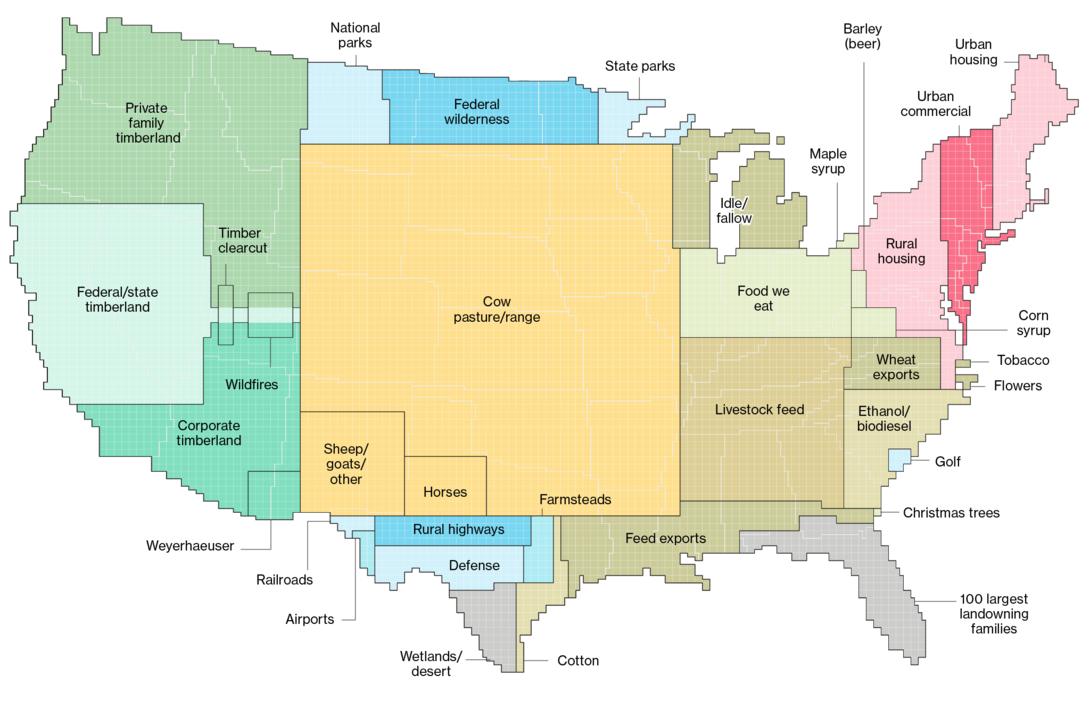
The old joke goes that aliens might think dogs rule Earth because humans pick up after them. That might need to be modified with the news that [the United States uses 41% of its land area to raise and feed cattle](https://www.bloomberg.com/graphics/2018-us-land-use/). That’s by far the biggest land use in America, and it’s used so that we can eat cows and drink their milk. All the other food we eat directly requires just a tenth of that; 4% of our land.

Goes with the theme from earlier this week on how [we have the resources to thrive, but don’t yet use them appropriately](http://bob.ryskamp.org/brain/dystopia-and-its-discontents/).

Found via the excellent [Information is Beautiful awards for 2018](https://www.informationisbeautifulawards.com/showcase/3257-here-s-how-america-uses-its-land).

Our geologic legacy

The Anthropocene is still getting started, but it’s unlikely to last forever–either we’ll transform ourselves or make ourselves extinct. In 50 million years, what will be left? Probably just a few centimeters of geologic debris:

> We note that effective sedimentation rates in ocean sediment for cores with multi-million-year-old sediment are of the order of a few cm/1000 years at best, and while the degree of bioturbation may smear a short-period signal, the Anthropocene will likely only appear as a section a few cm thick, and appear almost instantaneously in the record. – [The Silurian hypothesis: would it be possible to detect an industrial civilization in the geological record?](https://www.cambridge.org/core/journals/international-journal-of-astrobiology/article/silurian-hypothesis-would-it-be-possible-to-detect-an-industrial-civilization-in-the-geological-record/77818514AA6907750B8F4339F7C70EC6/core-reader)

10 minutes from dinosaurs

[Fascinating breakdown of exactly how the asteroid that wiped out the dinosaurs hit, and how scientists figured that out](https://www.3quarksdaily.com/3quarksdaily/2017/08/ten-minutes-difference-that-doomed-the-dinosaurs.html). Notably, if the asteroid hit 150 miles away, it wouldn’t have caused gypsum to vaporize in the atmosphere, and most animal life worldwide (including dinosaurs) would have survived.

> If the meteorite had arrived ten minutes earlier, or ten minutes later, it would still no doubt have inflicted devastation, but the dinosaurs would still be here and you wouldn’t.

Humanity and hegemony

I’ve always been shocked by humanity’s outsized impact on the earth. After all, we’re recent arrivals on the scene and there are far fewer of us than most animals and insects. We shouldn’t have affected big things like ecosystems yet, right?

Yet a new study found that [humans have destroyed 83% of all wild mammals and half of plants](https://www.theguardian.com/environment/2018/may/21/human-race-just-001-of-all-life-but-has-destroyed-over-80-of-wild-mammals-study) since civilization began. And today, 70% of all birds are farmed poultry, and 60% of mammals are livestock. As the article says, we are “simultaneously insignificant and utterly dominant in the grand scheme of life on Earth”.

One of the study’s authors [wrote](https://www.theguardian.com/environment/2018/may/21/human-race-just-001-of-all-life-but-has-destroyed-over-80-of-wild-mammals-study):

> When I do a puzzle with my daughters, there is usually an elephant next to a giraffe next to a rhino. But if I was trying to give them a more realistic sense of the world, it would be a cow next to a cow next to a cow and then a chicken. – Professor Ron Milo

[Another way to look at it](http://pbfcomics.com/comics/amends/):

Doing more with less

The fundamental challenge of our generation is to design lifestyles that everyone wants and the earth can support forever. [Buckminster Fuller put it well](http://www.geni.org/globalenergy/library/buckminster_fuller/buckyfullermemoriallecture.shtml):

> The possibility of a good life for any man depends upon the possibility of realizing it for all men. I must be able to convert the resources of the earth, doing more with less, until I reach a point where we can do so much as to be able to service all men in respect to all their needs.